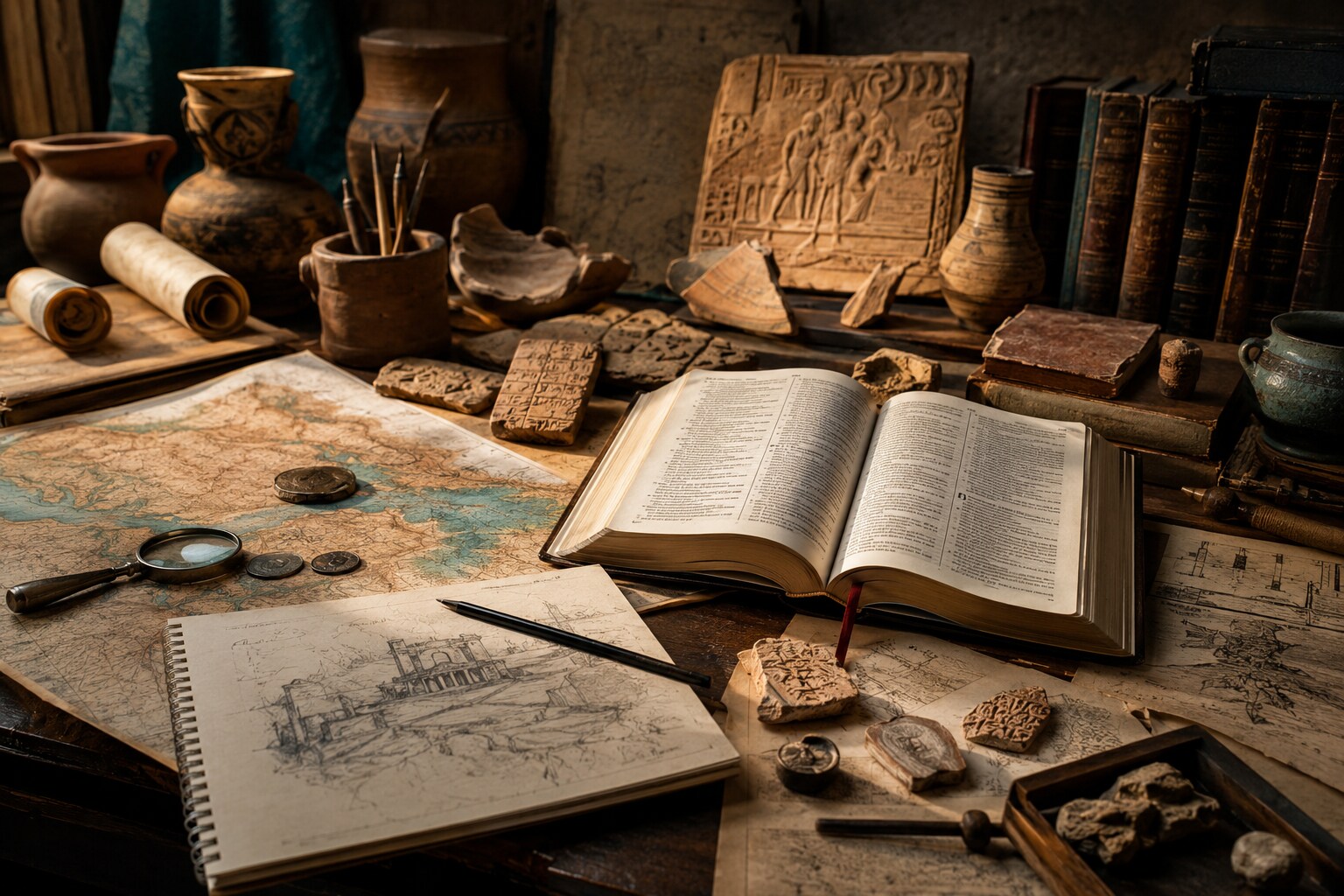
The biblical world contained farms, ports, roads, armies, courts, markets, villages, cities, temples, workshops, administrative offices, households, empires, and contested borders. Historical research helps transform vague antiquity into a more concrete environment in which the people, conflicts, metaphors, institutions, and journeys of the texts become easier to understand.
Environment
Geography creates possibilities and limits
Mountains, deserts, coastlines, rivers, agricultural zones, roads, and distances influence political control, trade, communication, warfare, migration, and ordinary travel. Modern maps can make ancient routes appear deceptively simple because they omit the practical experience of terrain. A journey of modest distance may involve steep elevation, seasonal weather, insecure roads, or border crossings. A city may matter because it controls a route rather than because of its physical size.
Geography also shapes language. Agricultural metaphors make sense differently when readers understand seasonal rain, harvest cycles, shepherding, vineyards, threshing, or water scarcity. Coastal trade creates different social contact than isolated upland settlements. Historical geography therefore does more than identify where an event occurred. It helps explain why a location could matter.
Empire
Political power reaches into ordinary vocabulary
Ancient communities lived under changing political systems. Imperial administration affected taxation, military presence, local leadership, citizenship, landholding, public building, coinage, law, travel, and status. Terms that modern readers encounter primarily in religious contexts may have existed alongside political and civic uses. Understanding those associations can change the emotional weight of a sentence without requiring readers to reduce every passage to political commentary.
Historical study should also resist treating an empire as a single uniform experience. Conditions varied by province, period, social class, legal status, and local administration. A wealthy urban citizen and a rural laborer could inhabit the same empire while encountering its institutions very differently. Context is strongest when it increases precision rather than replacing one broad assumption with another.
Material life
Objects can clarify practices that texts assume
Archaeological evidence provides information about buildings, pottery, tools, food production, burial, water systems, defenses, roads, inscriptions, coinage, household space, and regional trade. These remains can help readers visualize practices a text mentions without explanation because the original audience already understood them. A domestic image, agricultural action, architectural feature, or unit of money becomes less abstract when connected to physical evidence.
Archaeology must nevertheless be handled carefully. An object rarely arrives with a complete explanation of its meaning. Dating can be revised, site interpretation can be contested, and absence of evidence is not automatically evidence that something never existed. Responsible historical reading uses archaeology to constrain and illuminate possibilities rather than forcing discoveries to prove conclusions they cannot support.
Social structure
Households were economic and social units
Modern readers can hear words such as household, patron, servant, widow, inheritance, honor, citizenship, or hospitality through modern institutions. Ancient social arrangements differed significantly. Family relationships could carry economic, legal, and occupational dimensions. Patronage connected resources and status. Hospitality could involve obligations beyond casual friendliness. Public honor and shame could influence behavior in ways difficult to reproduce through a purely individualistic reading.
These structures should not be romanticized or treated as identical across centuries. They changed over time and differed across cultures. The purpose of context is not to make ancient institutions morally authoritative simply because they are ancient. It is to understand the situations the texts addressed so that description, criticism, accommodation, metaphor, and instruction can be distinguished more carefully.
Context viewer
Change the historical lens.
Geography changes movement and metaphor.
Routes, water, terrain, agriculture, distance, and regional boundaries influence where people travel, what they fear, what they grow, which cities become important, and which images feel immediately familiar to an ancient audience.
Method
Historical context should make interpretation more accountable
Context is sometimes used carelessly as a way to make a passage say whatever an interpreter already wants. Good historical work does the opposite. It narrows possibilities by asking what can actually be supported. Sources should be dated. Evidence should be connected to the correct region. Later customs should not automatically be projected backward. A practice known from one social group should not be assumed for everyone.
The result is rarely perfect reconstruction. Ancient evidence is incomplete, and many questions remain open. That incompleteness is not a reason to abandon historical research; it is a reason to describe conclusions with the appropriate degree of confidence. Well-established context can be stated firmly. Plausible reconstruction should be identified as plausible. Disputed claims should remain disputed.
This kind of caution makes the text more interesting rather than less. A passage no longer floats in an undefined biblical past. It belongs to a world of roads, taxes, languages, institutions, crops, architecture, occupations, social expectations, and political pressures. Historical research cannot answer every interpretive question, but it can prevent readers from unknowingly replacing an ancient world with their own.